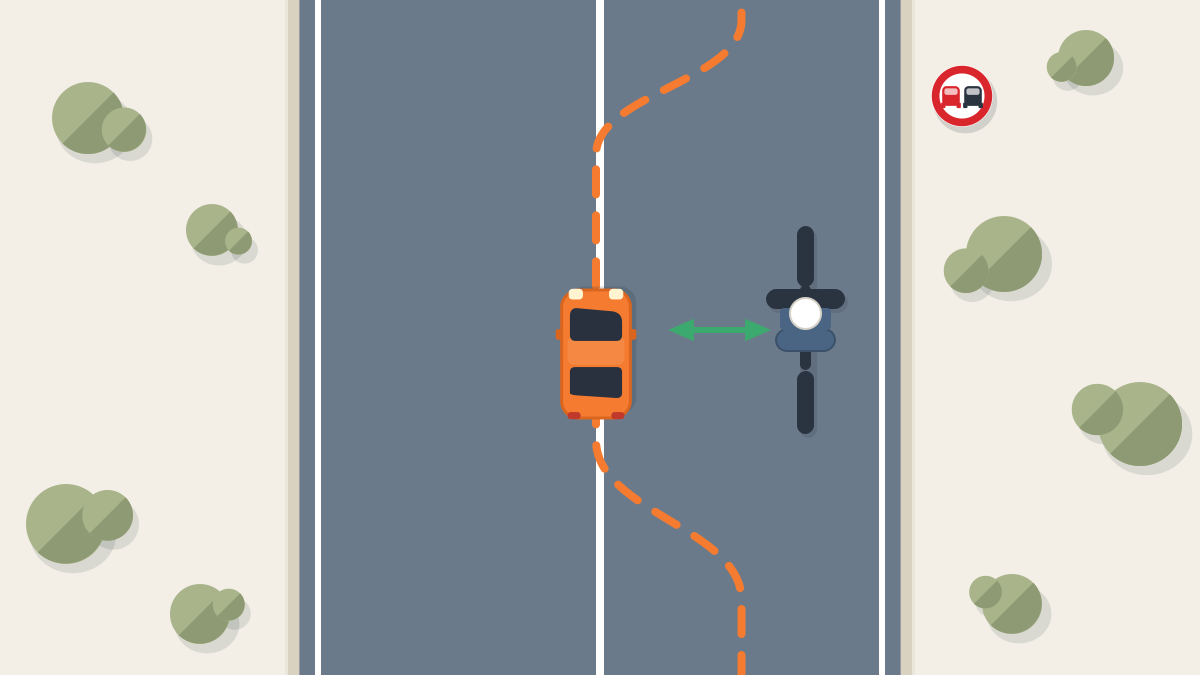
A country road, one lane each way. There's a solid line down the middle, and a little way back there was an R-305 “No overtaking” sign. Ahead of you a cyclist is doing about 20 km/h. Three cars have already stacked up behind you.
What to notice
- The driver behind may read the sign their own way and pull out to overtake you both at once.
- The cyclist isn't looking back and may drift half a metre to the left because of a pothole or the wind.
- An oncoming car may come over a crest before you've had time to get back into your lane.
- The driver behind isn't expecting you to slow down and closes right up, while you'll have to start the overtake from a low speed.
What to do
- Overtake only if you can see a long way along the oncoming lane: the R-305 “No overtaking” sign bans overtaking and the solid line bans crossing it, but cyclists are an exception, because passing one takes only seconds.
- Before you start, check your mirrors and over your shoulder and put your left indicator on.
- Outside built-up areas, from 1 October 2026, slow down before you start: the whole overtake must be at least 20 km/h below the limit, so with 90 on the sign, no faster than 70.
- Move partly into the oncoming lane, keep at least a metre and a half from the cyclist and pull back into your lane once you can see the whole cyclist in the rear-view mirror.
- Don't overtake a motorbike or a car across a solid line: the exception only covers slow road users such as a bicycle, a moped, an e-scooter or a tractor.
- If the view is short or the cyclist is going fast, stay behind.