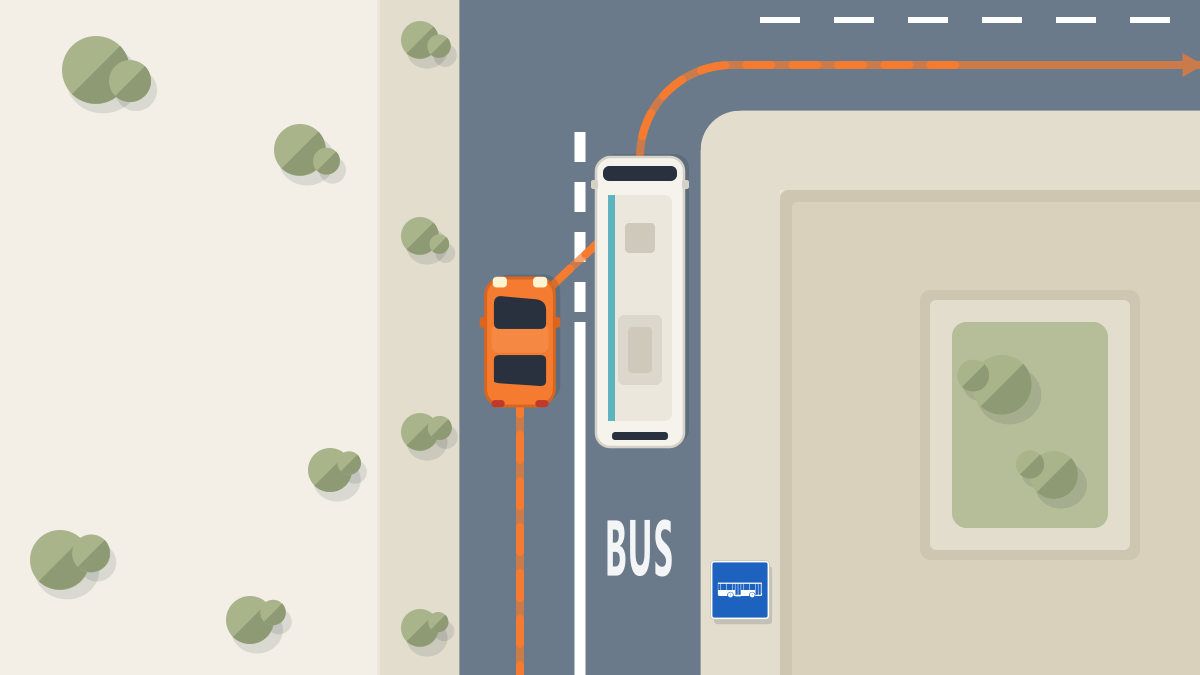
A city street with two lanes in your direction: you're in the left one, and the right one is for buses. It has BUS painted on it, and there's a sign on the pavement: S-51a “Lane reserved for specific vehicles” (Carril reservado para tipos específicos de vehículos). In a block you need to turn right. For now the bus lane is marked off by a solid line, and a bus is coming up along it behind you.
What to notice
- The bus in its own lane is moving faster than the traffic and isn't expecting you to pull in right in front of it.
- Taxis, motorbikes or cyclists may be using the bus lane too; the symbols on the S-51a sign show who.
- In many cities cameras on poles and on the buses themselves watch the bus lane.
- There's sometimes a bus stop in the bus lane before the junction: the bus may be standing right where you wanted to turn.
What to do
- While the bus lane is marked off by a solid line, stay in your lane: you mustn't cross a solid line, and driving in the bus lane where you're not allowed to costs 200 euros.
- Check the symbols on the S-51a “Lane reserved for specific vehicles” sign to see who else may use the lane.
- If there's a plate under the sign showing hours, bear in mind that the restriction only applies during those hours.
- Move into the bus lane only from where the line becomes a broken one, nearer the junction, and only to turn or to pull into a driveway: not to stop, make a U-turn or overtake.
- Check your right mirror and over your shoulder, put your right indicator on and, if a bus is close behind, let it go by: in this lane the right of way belongs to those it's meant for.
- Then move over and make your turn from that lane: don't turn right straight from your own lane across the bus lane, because that way you cut in front of whoever is going straight on in it, whether a bus, a taxi or a cyclist.