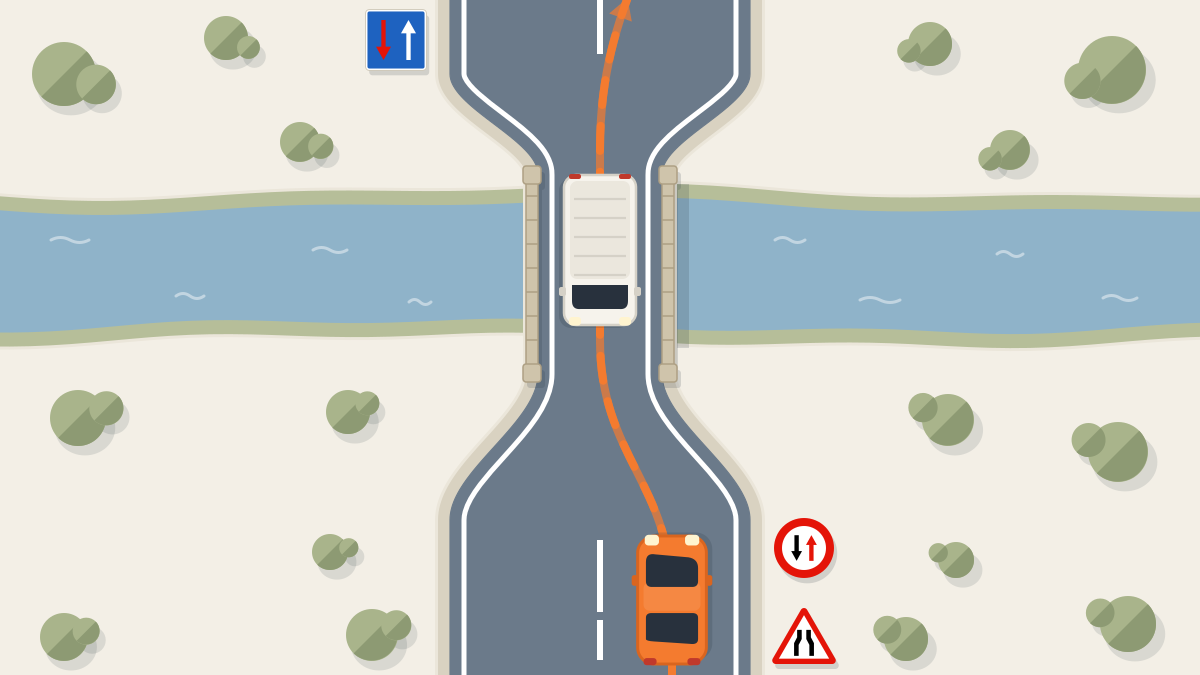
A country road narrows before an old bridge: two cars can't pass each other on it. On your side there are signs P-17 “Road narrows” (Estrechamiento de calzada) and R-5 “Priority to oncoming traffic” (Prioridad del sentido contrario). From the other bank, a van is approaching the bridge, and it's about as far from the entry as you are.
What to notice
- The van has its own sign, R-6 “Priority over oncoming traffic” (Prioridad respecto al sentido contrario), and it isn't going to brake.
- If you both drive on, one of you will have to reverse back along the bridge, and other cars have already pulled up behind.
- The road before the bridge often has a bend: you only see the oncoming vehicle at the last moment.
What to do
- As you approach the bridge, check which sign is on your side.
- With sign R-5 “Priority to oncoming traffic” you give way: stop before the narrow section without entering it, and let all oncoming traffic through, both those already on the bridge and those arriving from the far end.
- If you've driven on anyway with someone coming the other way, you're the one who reverses.
- With sign R-6 “Priority over oncoming traffic” you have right of way, but if an oncoming vehicle has already driven onto the bridge, let it come off.
- If there are no signs, whoever entered the narrow section first goes first.
- If it isn't clear who was first, whoever manoeuvres more easily reverses: a car gives way to a lorry, a bus or a vehicle with a trailer, a motorbike to a car, and of two of the same kind, the one nearer the end of the section.