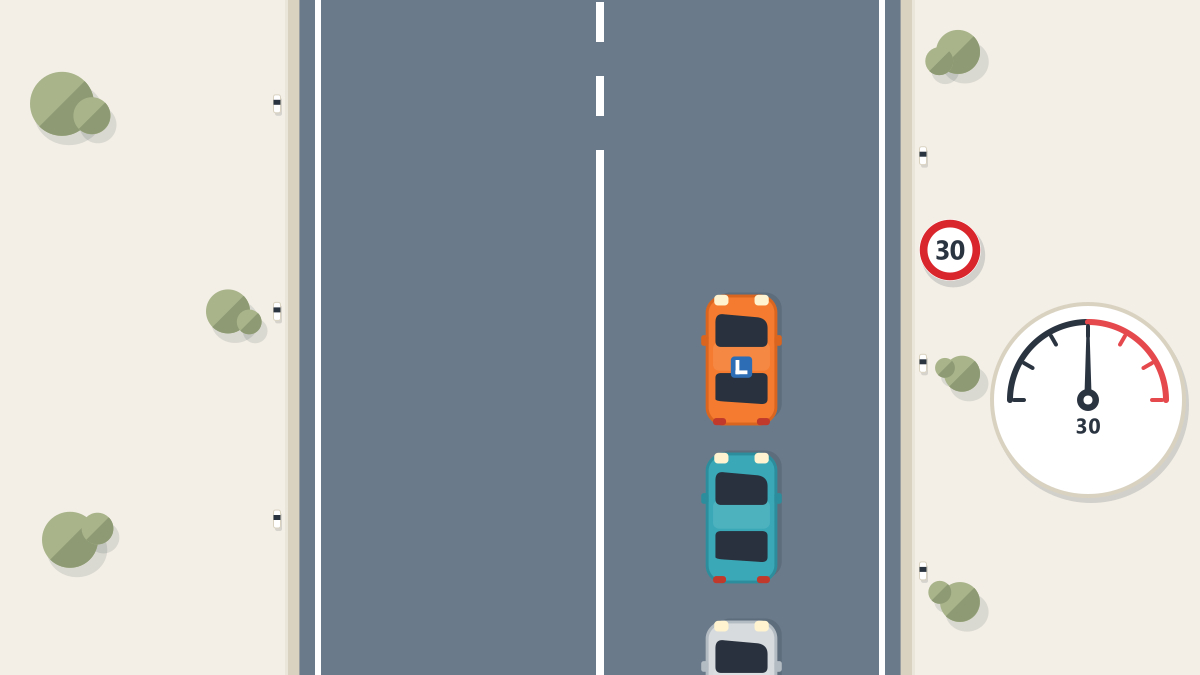
A street with one lane each way, a 30 km/h limit, and you're holding exactly 30. A queue has built up behind you and the instructor asks you to speed up: a couple of extra km/h seems like nothing.
What to notice
- The cars behind sit on your bumper and hoot, but you don't have to hurry: the learner plate gives nobody the right to rush you.
- Someone will overtake where it's allowed: hold your lane and don't speed up along with them.
- Other cars may be going faster, but that doesn't change your limit.
- Nobody expects a learner car to accelerate hard, so other drivers may not react in time.
What to do
- Work out your speed from the sign and the type of street, not from the traffic around you: a sign with a different number overrides the general rule.
- With no sign, apply the town limits: 20 km/h on a shared-surface street with no separate pavement, 30 km/h with one lane in your direction and 50 km/h with two or more; a bus lane doesn't count.
- Calmly tell the instructor that you're driving at the limit: nobody has a margin above it, a learner car included, and an instructor who asks you to speed up is pushing you into an offence.
- Keep slightly below the limit and glance at the speedometer when the road allows: in the exam, speeding counts as a fault, and the bigger the excess, the more serious the fault, up to a fail.