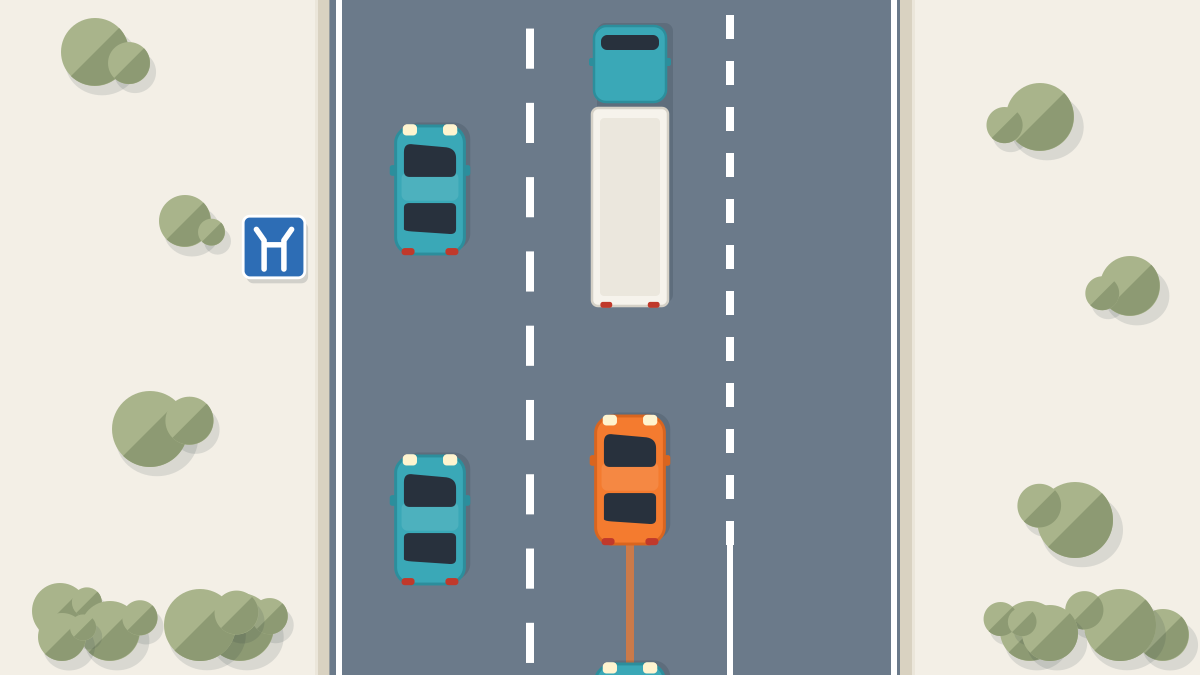
You're joining an autovía (a Spanish dual carriageway) from a local road. On your left the traffic is doing 120 km/h, and there's a lorry in the right-hand lane. The acceleration lane ends in a couple of hundred metres, and you're doing about 60 km/h.
What to notice
- The driver in the right-hand lane doesn't have to let you in, and may have nowhere to move over to on the left.
- Someone in the left-hand lane may move right without checking the mirror, straight into the gap you picked.
- The car behind you in the acceleration lane is speeding up and isn't expecting you to brake.
- A lorry takes a long time to slow down and may not manage to make room for you.
What to do
- Check your left mirror while you're still on the slip road, before the lane begins.
- Pick a gap you can slot into at the speed of the traffic: usually the space right behind the nearest car.
- If there's a gap, put your left indicator on, accelerate to the traffic's speed and merge smoothly before the lane ends.
- If there isn't, deal with it at the start of the lane, while all of it is still ahead of you: ease off early and keep your distance. As a last resort, stop there with your hazards on and let the traffic pass.
- Don't stop at the end of the lane: nobody there expects a stopped car.
- If there's no acceleration lane at all, pull out only into a very big gap.