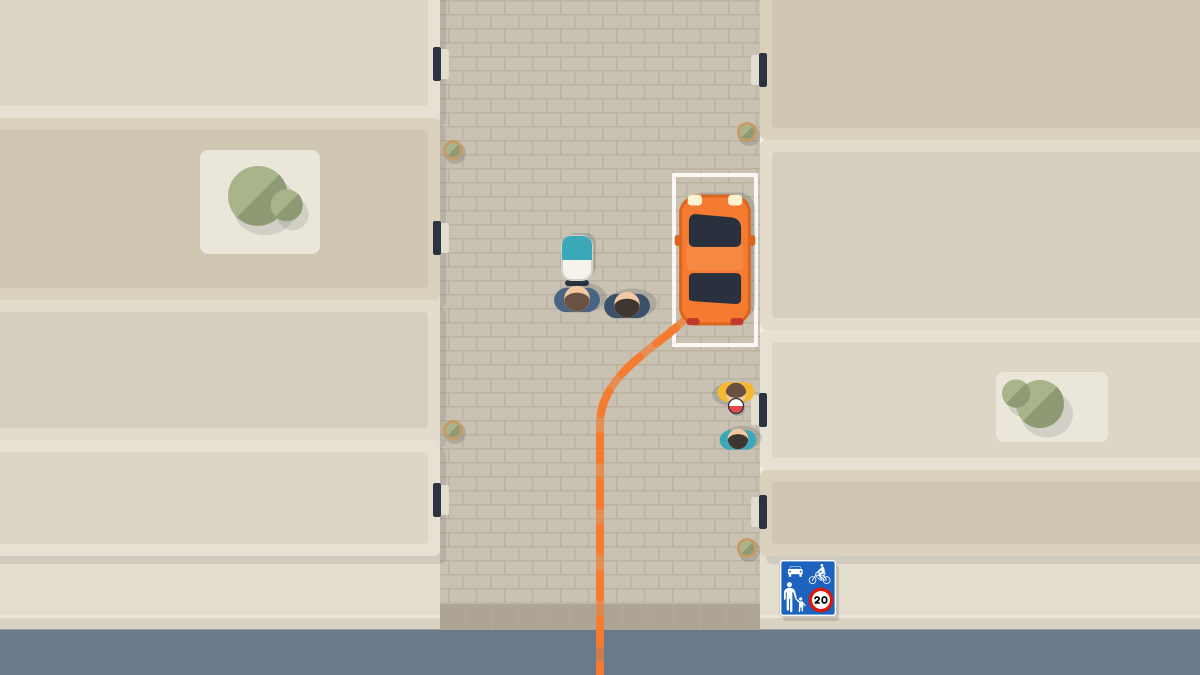
You turn into a street in the old town: there's no kerb, the road and the pavement are laid with the same paving at the same level, and at the entrance there's an S-47 “Shared zone” (Zona de coexistencia) sign. A couple with a pushchair are walking slowly down the middle of the street, and children are playing by a doorway. From here it's the shortest way to where you're going to park.
What to notice
- Pedestrians here walk wherever it suits them and don't have to look round at the sound of an engine.
- Children run out of a doorway or from behind a car at any moment.
- Cyclists and e-scooters may ride along a street like this in both directions, even if cars may only go one way.
- Cars left outside the marked spaces narrow the way through, and it's hard to pass an oncoming car.
What to do
- Recognise a street like this: no kerb, the pavement and the road at the same level with the same paving throughout, or an S-47 “Shared zone” sign at the entrance.
- Keep to 20 km/h at most, and to walking pace when you're near people.
- Give way to pedestrians anywhere on the street: they may walk across its whole width and don't have to step aside for cars, so don't sound your horn and don't squeeze past, wait for them to clear the way.
- Park only where a sign or road markings allow it.
- Under the S-28 “Home and play zone” (Zona de estancia y juego) sign apply the stricter rule: the limit is always 10 km/h and children are allowed to play right on the road; these signs and rules were updated in 2025–2026.