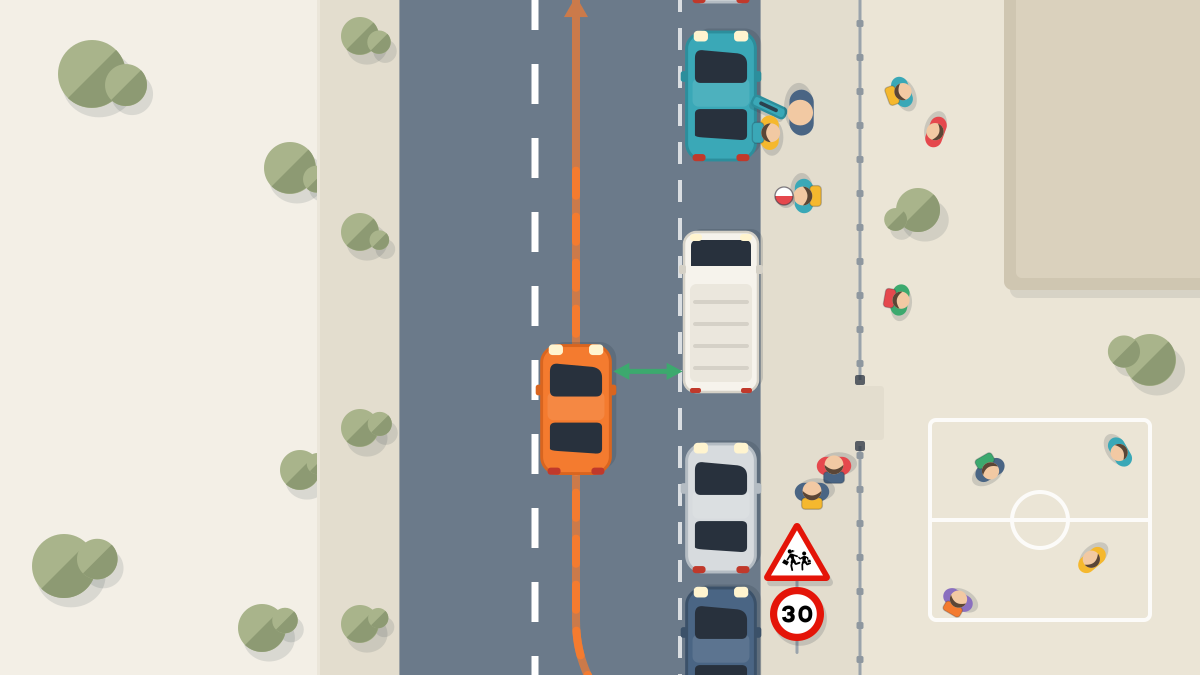
It's morning and you're driving past a school; the R-301 “Maximum speed” (Velocidad máxima) sign says 30 km/h. There's an unbroken line of cars along the pavement, and one has its rear door open. On the pavement there are children with backpacks, and someone is running after a ball.
What to notice
- A child is lower than a bonnet: behind a parked van you can't see them until they're in the road.
- Children who are running late dash across anywhere, not at the crossing.
- A parent may open the car door on the road side to drop a child off.
- The car in front may suddenly stop right in the lane to drop a child off.
What to do
- Slow down before you even reach the sign and keep your foot over the brake: near schools and wherever there may be children, you have to drive at a moderate speed and be ready to stop, even if the sign allows more.
- Move away from the stationary cars as far as the oncoming lane allows, and look under the cars and between them: you'll see feet and a ball before you see the child.
- Don't go round a car that has stopped before a crossing: overtaking at a pedestrian crossing is prohibited, and there may be a child walking on the other side of it.
- Go especially slowly past a stationary school bus.
- Drop your own children off only where stopping is allowed, and on the pavement side.